

Resistance Bands for POTS and Dysautonomia — Safe Strength Training at Home
Most exercise advice for POTS patients runs into the same wall: you can't build the capacity you need through upright exercise when upright exercise is precisely what makes you symptomatic. The problem isn't laziness or deconditioning in the conventional sense. It's that the brain's regulatory maps for managing blood flow under gravitational load have become unreliable — and trying to rebuild them through the very activity that stresses those maps tends to backfire.
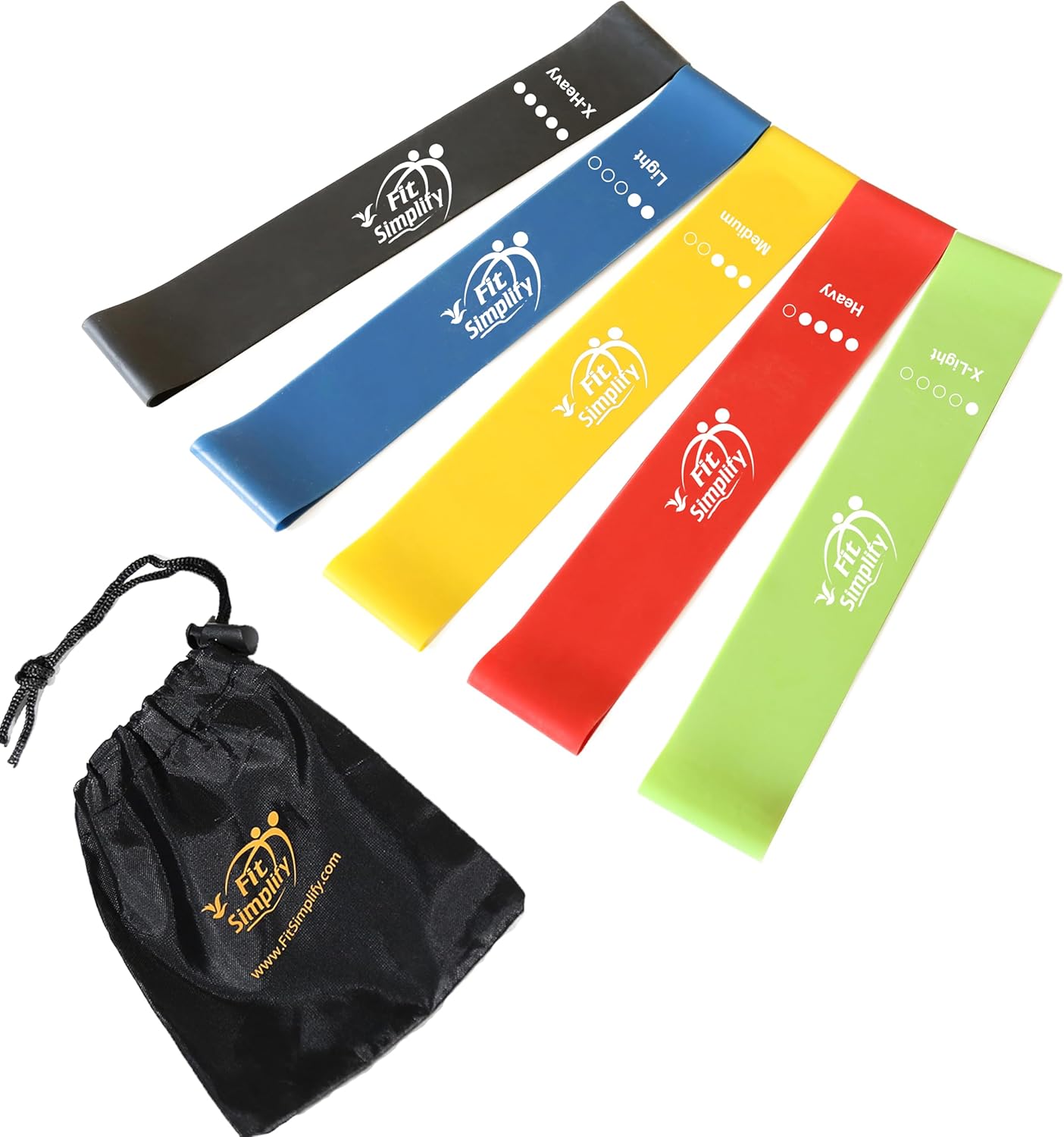
Resistance training changes the equation. Done from a seated or supine position, it removes orthostatic stress from the equation entirely while still providing meaningful mechanical load to muscles. The Fit Simplify Resistance Loop Bands — a set of five bands spanning a genuine range of resistance levels — are one of the most practical tools for implementing this kind of graded, position-independent strength work at home.
Why Strength Training Matters for Dysautonomia
There's a common but oversimplified narrative that exercise helps POTS by expanding blood volume. That's partially true but misses the more important mechanism. The autonomic nervous system's job is to coordinate cardiovascular response in real time as body position changes. When that coordination breaks down, what the system needs isn't simply more blood — it needs graduated stimulation at tolerable intensity so the brain can rebuild the neurovascular maps that govern that coordination.
Resistance training contributes to this in at least two ways. First, it creates local muscle contractions that drive venous return mechanically — the calf and thigh muscles act as pumps, pushing blood back toward the heart when they contract. Second, it provides the autonomic nervous system with a low-stakes training environment: cardiovascular demand is present, but because you're horizontal or seated, the orthostatic challenge that triggers dysautonomia symptoms is absent. The brain gets exercise-related signals without the gravitational stress that would overwhelm its regulatory capacity.
Research on bed rest and inactivity underscores why this matters. Bed rest progressively impairs baroreflex sensitivity and cardiovascular reflexes — which means that complete rest isn't neutral. Inactivity actively degrades the systems that standing and movement require. Resistance training, even at low intensity and in horizontal positions, interrupts that degradation.
The EDS Connection
For patients with Ehlers-Danlos syndrome or hypermobility spectrum disorders — conditions that frequently co-occur with POTS — resistance training carries an additional rationale. Hypermobility doesn't just mean loose joints. It means the proprioceptive and neuromuscular systems that govern joint stability and positional sense are operating on unreliable input. The brain's body map becomes imprecise.
Structured rehabilitation programs for EDS specifically target neuromuscular control — the ability of muscles to activate in coordinated sequences to protect joints that ligaments can't fully stabilize. Resistance band work, because it provides both mechanical load and proprioceptive feedback through controlled range of motion, is one of the more effective tools for rebuilding this control.
The key word is graduated. Resistance training is safe and effective even in confirmed genetic EDS — but the bands need to match where you actually are, not where you want to be. Starting with the lightest band and performing exercises that don't stress hypermobile joints into end-range positions is standard practice. The set of five bands allows genuine progressive overload: you advance when your body has adapted to the current level, not on a calendar schedule.
Practical Application
The most useful exercises for this population are those that load the muscles of the lower limbs and core without requiring standing: supine leg presses against band resistance, clamshells, seated rows, lateral band walks in a partial squat, and glute bridges. All of these can be performed on the floor or in a chair. None require upright posture.
The instruction guide included with the Fit Simplify set provides a starting framework, though most POTS and EDS patients will want to adapt exercises to their position tolerance and symptom threshold. The general principle is to work within the range of motion and resistance that doesn't trigger post-exertional symptom amplification — to give the system a signal it can respond to, not one it has to survive.
The five resistance levels (extra light, light, medium, heavy, extra heavy) provide enough range to accommodate both a newly diagnosed patient starting cautiously and someone further along in rehabilitation who can handle more load. For most people starting from significant deconditioning, the extra light band will feel appropriately challenging.
What to Track
If you're managing POTS or ME-CFS alongside EDS, tracking orthostatic symptoms in the 24 hours following a resistance session gives you better data than tracking during the session itself. Delayed symptom amplification — worsening heart rate dysregulation or fatigue appearing the following day — is a more reliable signal that you've exceeded your current threshold than symptoms during the exercise itself. Keeping sessions short and consistent is more effective than pushing for duration or intensity.
Resistance bands aren't a cure and they don't replace the medical management of dysautonomia. But they provide a practical, accessible, position-adaptable tool for the kind of graded physical stimulation that the brain's autonomic regulatory system needs to maintain and rebuild its capacity.