

Red Light Therapy for ME/CFS and Dysautonomia — The Mitochondrial Angle
ME/CFS is not a condition of perceived fatigue. It is a condition of measurable metabolic failure. Research has now documented that immune cells in ME/CFS show reduced bioenergetic function — they produce less ATP, operate under greater oxidative stress, and recover more slowly from energetic demand. This is not an incidental finding at the margins of the research; it is one of the most consistent and replicated findings in the field. And it extends beyond immune cells: ME/CFS has a measurable metabolic fingerprint in blood, with distinct abnormalities in amino acid profiles, lipid metabolism, and indicators of mitochondrial strain.
It is from this foundation — documented mitochondrial dysfunction, measurably impaired cellular energy production — that the mechanistic interest in red and near-infrared light therapy derives. Not from anecdote. Not from general wellness culture. From the question: if ATP production is impaired at the cellular level, are there ways to support the machinery that makes ATP? And the photobiomodulation literature says: possibly yes, through a specific and reasonably well-characterized mechanism.
The Mechanism: Cytochrome c Oxidase
The key target of red and near-infrared light is cytochrome c oxidase — Complex IV in the mitochondrial electron transport chain. This is the terminal enzyme of the chain: the one that accepts electrons from upstream carriers and reduces oxygen to water, driving the proton gradient that powers ATP synthase. It is also a chromophore — it absorbs light at specific wavelengths, particularly in the red (around 630-680nm) and near-infrared (around 810-850nm) ranges.
When cytochrome c oxidase absorbs photons at these wavelengths, it undergoes conformational changes that increase its activity. The downstream effect is increased electron transport efficiency and, consequently, increased ATP production. There is also evidence of secondary effects: reduced reactive oxygen species, modulation of nitric oxide (which normally inhibits cytochrome c oxidase), and downstream changes in gene expression related to cellular repair and anti-inflammatory signaling.
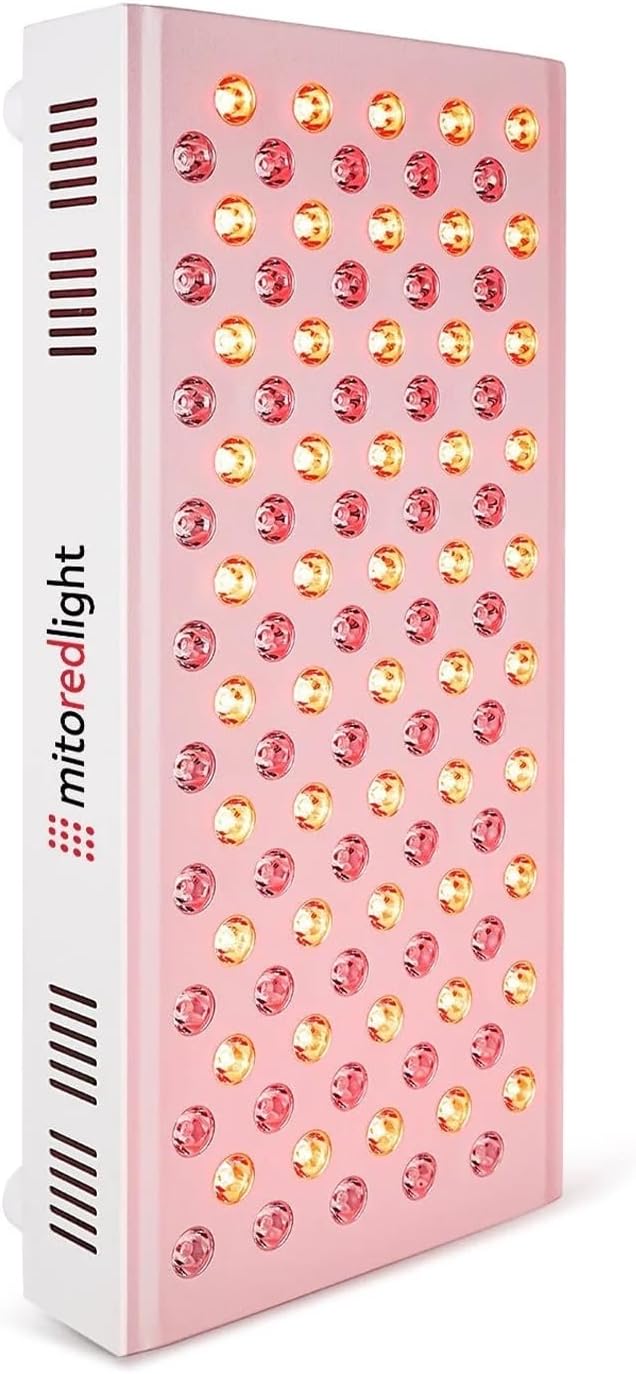
The two wavelengths in the MitoMID — 660nm (red) and 850nm (near-infrared) — represent the two primary absorption peaks of cytochrome c oxidase in tissue. They also have different penetration depths. The 660nm wavelength penetrates several millimeters into tissue, making it effective for surface-level structures: skin, superficial vasculature, peripheral nerve endings. The 850nm near-infrared wavelength penetrates more deeply — several centimeters — reaching muscle tissue, deeper vasculature, and to a limited extent subcutaneous fat. Running both wavelengths together provides coverage across the depth spectrum.
What This Is — and What It Is Not
Direct evidence for red light therapy in dysautonomia specifically is limited. There are no large, well-controlled trials of photobiomodulation in POTS or dysautonomia populations, and this page is not going to pretend otherwise. What exists is: a reasonably well-characterized cellular mechanism, replicated in laboratory conditions across multiple research groups; a body of clinical evidence in adjacent conditions (wound healing, muscle recovery, certain inflammatory conditions); and the documented metabolic abnormalities in ME/CFS that make mitochondrial support mechanistically relevant rather than speculative.
The honest framing is this: red light therapy is a mitochondrial support intervention, mechanistically grounded in a cellular target that is measurably impaired in ME/CFS. It is not a treatment for dysautonomia. It is not proven to resolve fatigue in ME/CFS. It is a tool that some patients report benefit from, with a plausible mechanism, an acceptable safety profile at standard exposures, and no conflict with other treatment approaches. That is the basis on which it belongs in a resources section of this kind.
Why the MitoMID
The MitoMID is Mito Red Light's mid-size full panel — a larger treatment area than the desktop MitoMIN, designed for full-body or large-area sessions. The practical implication: you can treat a larger surface area in a single session without repositioning. For patients who want to address systemic metabolic support rather than a single targeted area, this matters. Full torso coverage in one 15-minute session is achievable with a panel at this size.
The unit hangs from a door-mounted bracket or can be stand-mounted, allowing treatment from a standing, sitting, or reclining position. For patients whose energy is variable, the ability to do sessions seated or lying down is not trivial.
Protocol Guidance
Standard protocols in the photobiomodulation literature use sessions of 10-20 minutes, three to five times per week, at distances of 6-18 inches from the panel depending on the target tissue depth and the unit's power output. Closer distances deliver higher irradiance; near-infrared penetration is improved at closer range. Start conservatively — 10 minutes, moderate distance — and assess response before extending session length. Some patients with ME/CFS report post-exertional sensitivity even to light therapy sessions; if that is the case, reduce session length and frequency rather than discontinuing entirely.
The exercise intolerance in ME/CFS is a blood flow and delivery problem — passive interventions that support cellular function without triggering the post-exertional response are of particular interest in this population. Red light therapy is passive: it requires no metabolic output from the patient during the session. This distinguishes it from active interventions that carry PEM risk.