
Desktop Red Light Therapy for ME/CFS and Dysautonomia — Targeted Treatment for Limited Mobility
The mechanism underlying the interest in red light therapy for ME/CFS and dysautonomia starts at the cellular level: cytochrome c oxidase, the terminal enzyme of the mitochondrial electron transport chain, absorbs red and near-infrared photons and responds with increased activity — more efficient electron transport, greater ATP output. This is not speculative. It is a documented photochemical interaction, replicated across research groups, with downstream effects on nitric oxide regulation, reactive oxygen species, and cellular repair signaling.
The relevance to ME/CFS is direct. Immune cells in ME/CFS show reduced energy production — measurably impaired bioenergetics, lower ATP yield, slower recovery from energetic demand. This is documented in multiple cell types and is among the most replicated findings in ME/CFS metabolic research. And ME/CFS has a measurable metabolic fingerprint in blood — distinct abnormalities in metabolic markers that persist across patient populations and are not explained by deconditioning alone.
From that foundation, photobiomodulation's mechanism — stimulating the enzyme responsible for mitochondrial ATP production — is mechanistically relevant, not merely fashionable. This page is about the compact version of Mito Red Light's panel lineup: the MitoMIN.
MitoMIN vs. MitoMID: When to Choose Which
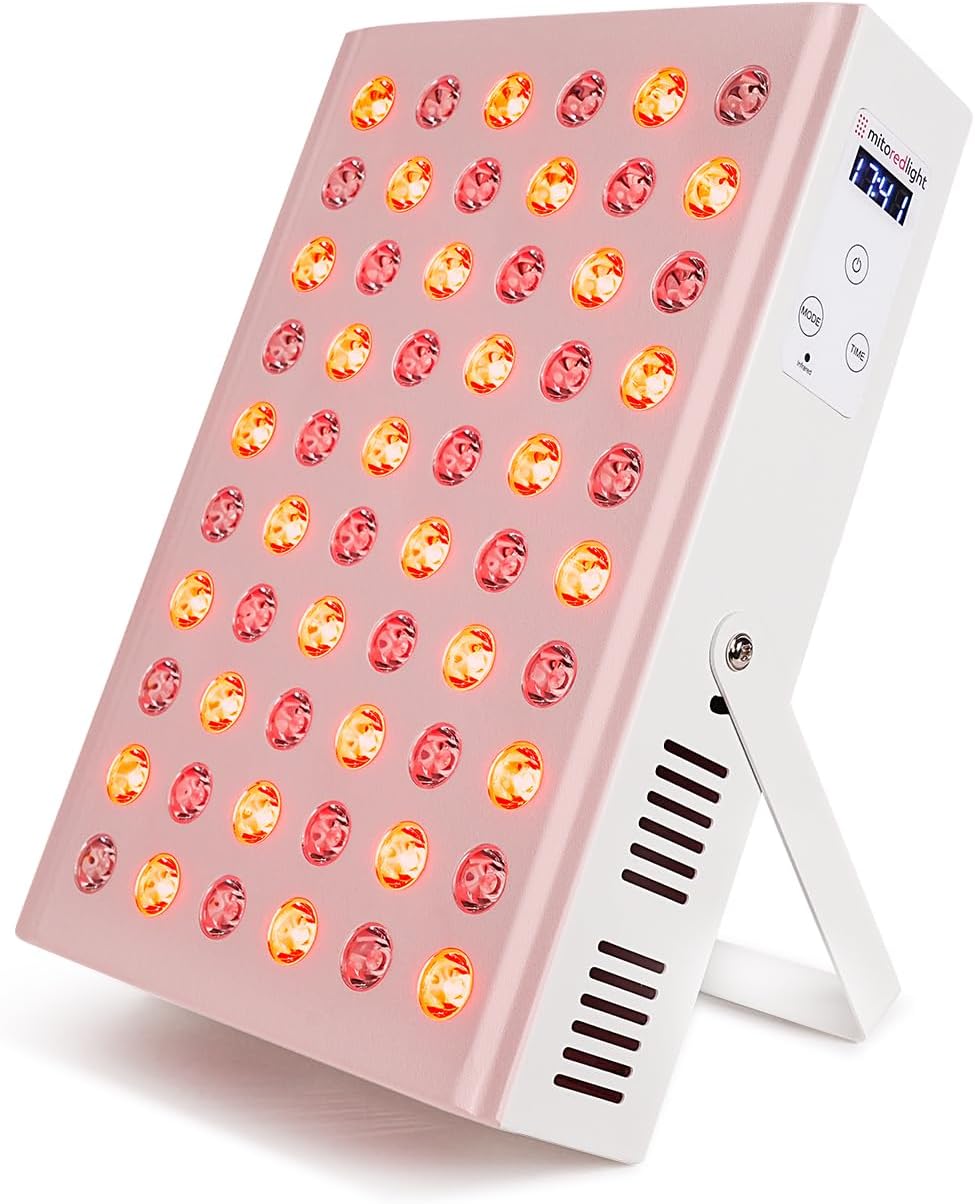
The MitoMIN and MitoMID share the same core technology — 660nm red light and 850nm near-infrared light, the two primary absorption peaks of cytochrome c oxidase in tissue. The difference is form factor and treatment area.
The MitoMID is a full panel designed for broad-area and full-body sessions. It is appropriate for patients who want to run systemic sessions — trunk, back, legs — and have the space and mobility to set it up on a door bracket or stand and position themselves in front of it. If that description fits your situation, the MitoMID offers more coverage per session.
The MitoMIN is a compact desktop device. It sits on a surface — a bedside table, a desk, a tray — and delivers targeted treatment to a smaller area. For patients with severe ME/CFS, significant orthostatic limitations, or mobility constraints that make standing in front of a panel for 15 minutes impractical, this is the more realistic option. It can be used from bed or from a chair. It can be positioned at face level, aimed at the chest, placed beside the arm for targeted limb treatment. The logistics of actually using it are lower-barrier.
The MitoMIN is also the more appropriate entry point for patients who want to explore photobiomodulation without committing to a full panel purchase. The mechanism is the same; the treatment area per session is smaller; the cost is lower. Try it on a targeted basis, assess your response, and then decide whether broader-area treatment with a full panel makes sense for you.
Targeted Use Cases
For ME/CFS patients, specific use cases for targeted red light treatment are worth thinking through explicitly rather than treating it as a generic wellness tool.
Facial treatment — covering the cheeks, forehead, and jaw — delivers light to superficial vasculature and the facial muscles involved in autonomic expression. Some patients report reduced headache frequency and improved cognitive clarity from regular facial sessions, though this is anecdote rather than established outcome data. The mechanism for any neurological effect would involve penetration through tissue to cranial vasculature and superficial brain structures — limited but not zero at 850nm.
Targeted muscle treatment — particularly large muscle groups like the quadriceps or back muscles — is better supported in the photobiomodulation literature. Muscle recovery, reduction in delayed-onset soreness, and support for mitochondrial function in skeletal muscle tissue have been studied with reasonable rigor. For ME/CFS patients, whose exercise intolerance involves documented blood flow and metabolic delivery problems, supporting muscle tissue recovery after even mild exertion has logical value.
The Evidence Caveat — Said Plainly
There are no large randomized controlled trials of red light therapy in POTS, in dysautonomia generally, or in ME/CFS populations at the scale that would establish it as an evidence-based treatment. The interest from this site's perspective is mechanistic: ME/CFS involves documented mitochondrial impairment, and red light therapy acts on the specific enzyme most directly responsible for mitochondrial ATP production. That is a mechanistic argument for relevance, not a clinical argument for proven efficacy.
Be appropriately skeptical of anyone framing photobiomodulation as a cure or a guaranteed treatment for these conditions. It is a low-risk supportive intervention with a plausible mechanism and some patient-reported benefit. The safety profile at standard consumer exposures is good — avoid looking directly at the lights, follow recommended distances, and don't dramatically exceed session lengths. There is no meaningful harm risk from normal use.
Consistency Over Intensity
The photobiomodulation literature consistently supports frequency of use over single-session intensity. Three to five sessions per week at 10-15 minutes each, at a consistent distance of 6-12 inches, produces better outcomes than occasional longer sessions. The MitoMIN's desktop form factor makes daily consistency achievable in a way that a full panel setup may not be for patients with limited energy and variable capacity. It is on the table when you sit down at your desk. It is on your bedside table when you wake up. Friction matters for consistency when energy is the limiting resource.
For patients dealing with the psychological weight of a condition that is frequently dismissed, being disbelieved has real physiological consequences — the added stress load of navigating skeptical medical encounters compounds the underlying autonomic instability. Tools that patients control directly, that are passive, that carry no PEM risk, and that are grounded in documented biology rather than ideology, have value beyond their specific mechanism. This is one of them.