

Electrolytes for POTS and Dysautonomia — What They Actually Do (And Don't Do)
If you have POTS or dysautonomia, you have almost certainly been told to drink more salt water. It is one of the first things clinicians recommend, and it is not wrong exactly — but the explanation behind it is often oversimplified in ways that lead to unrealistic expectations. Most patients try high-sodium fluids, feel partial relief, and then wonder why it wears off by early afternoon or stops working after a few weeks. The answer has to do with what electrolytes actually address in dysautonomia — and what they do not.
The Standard Narrative and Where It Falls Short
The conventional framing goes like this: POTS involves low circulating blood volume, so adding salt and water expands that volume, giving the heart more to work with when you stand up. This is true in a narrow sense, but it treats the condition as though the problem is purely about how much fluid you have. For most dysautonomia patients, the problem is not total volume — it is where that volume goes and how well the system regulates its distribution.
Think of it like a fish tank with a pump that circulates water to the top. The tank might be completely full, but if the pump is underperforming, the water at the top isn't getting replenished. Pouring more water into the tank doesn't fix the pump. It might temporarily help — if you overflow the tank, water gets everywhere, including the top — but the underlying circulation failure is unchanged. The moment you stop adding water, the same pattern reasserts itself.
This is why research on regional blood volume in POTS finds that the issue is distribution, not depletion. Blood is pooling in the periphery because the vasomotor system isn't directing it correctly — not because there simply isn't enough of it. IV saline produces temporary improvement in many patients for exactly this reason: it briefly overwhelms the distribution failure by flooding the system. When it wears off, the regulatory deficit remains.
The Renin-Aldosterone Paradox
There is an important exception to this picture, and it changes the calculus for a meaningful subgroup. Some POTS patients have a measurable hormonal abnormality in which the renin-aldosterone system — the body's primary volume-retention mechanism — fails to respond appropriately to the low-volume signals it is receiving. Normally, when circulating volume drops, aldosterone rises to retain sodium and water through the kidneys. In some patients, this feedback loop is blunted: the signal is there, but the response is insufficient.
For this subgroup, the renin-aldosterone paradox represents genuine absolute volume depletion — not just a distribution problem. For these patients, high-sodium supplementation has more direct mechanistic relevance because the body is actively failing to retain what it receives. Electrolyte loading gives the system more raw material to work with even when aldosterone signaling is impaired.
Whether you fall into this subgroup is something a clinician can investigate through laboratory testing. But even here, the electrolytes are addressing a hormonal regulatory failure — they are not restoring normal autonomic function.
What Electrolytes Actually Do Well
Despite the caveats, there are clear and legitimate reasons to use high-quality electrolytes in dysautonomia management. The body's cardiovascular system requires a narrow range of plasma osmolality to function correctly. When sodium and associated electrolytes (potassium, magnesium, chloride) are adequately maintained, the cardiovascular system performs better under orthostatic load. Heart rate excursions are smaller. Blood pressure is better maintained. Symptoms — while not eliminated — are less severe and shorter in duration.
Electrolytes are also essential for muscle function, including the smooth muscle of blood vessels. Adequate magnesium and potassium support vascular tone, which is exactly what breaks down during orthostatic stress in dysautonomia. Maintaining adequate levels doesn't fix the regulatory deficit, but it removes a confounding variable that makes the deficit worse.
High-quality hydration also supports baroreflex function. Baroreceptors — the pressure-sensing nerves in the major blood vessels — require a well-hydrated, appropriately osmotic blood environment to send accurate signals. A depleted, low-sodium state impairs baroreceptor accuracy, compounding the autonomic signaling problem.
Why Formulation Quality Matters — Including the Role of Sugar
Not all electrolyte products deliver meaningful sodium or mineral content. Many commercial sports drinks and "hydration packets" are formulated primarily for flavor and sugar content, with sodium levels that are trivial by dysautonomia standards. The ranges typically recommended in dysautonomia management — 3,000–10,000 mg of sodium per day depending on severity and physician guidance — require a product with a genuinely high electrolyte concentration.
There is also a mechanism that most electrolyte marketing ignores entirely: oral sodium absorption depends on glucose. The small intestine uses a transporter called SGLT1 — the sodium-glucose cotransporter — to move sodium actively across the intestinal wall and into circulation. SGLT1 requires glucose to function. Without glucose present, sodium absorption falls back on a slower, passive process that is substantially less efficient. This is not theoretical: it is the reason oral rehydration solutions (developed for cholera treatment) have included glucose since the 1970s, and why IV saline bypasses the issue entirely — it enters circulation directly, never interacting with intestinal transporters at all.
The implication for electrolyte products is direct. Completely sugar-free formulations — LMNT is the prominent example in the dysautonomia community — lack the glucose required to drive SGLT1 efficiently. The sodium you consume may not absorb at the rate the label implies. What is not absorbed does not stay in your gut indefinitely: the kidneys filter and excrete unretained sodium, which carries water with it. For patients already struggling with fluid balance, a product that bypasses the absorption mechanism could plausibly worsen the very problem it is supposed to address. Whether this is clinically significant likely varies by patient and volume consumed, but the physiology is not in dispute.
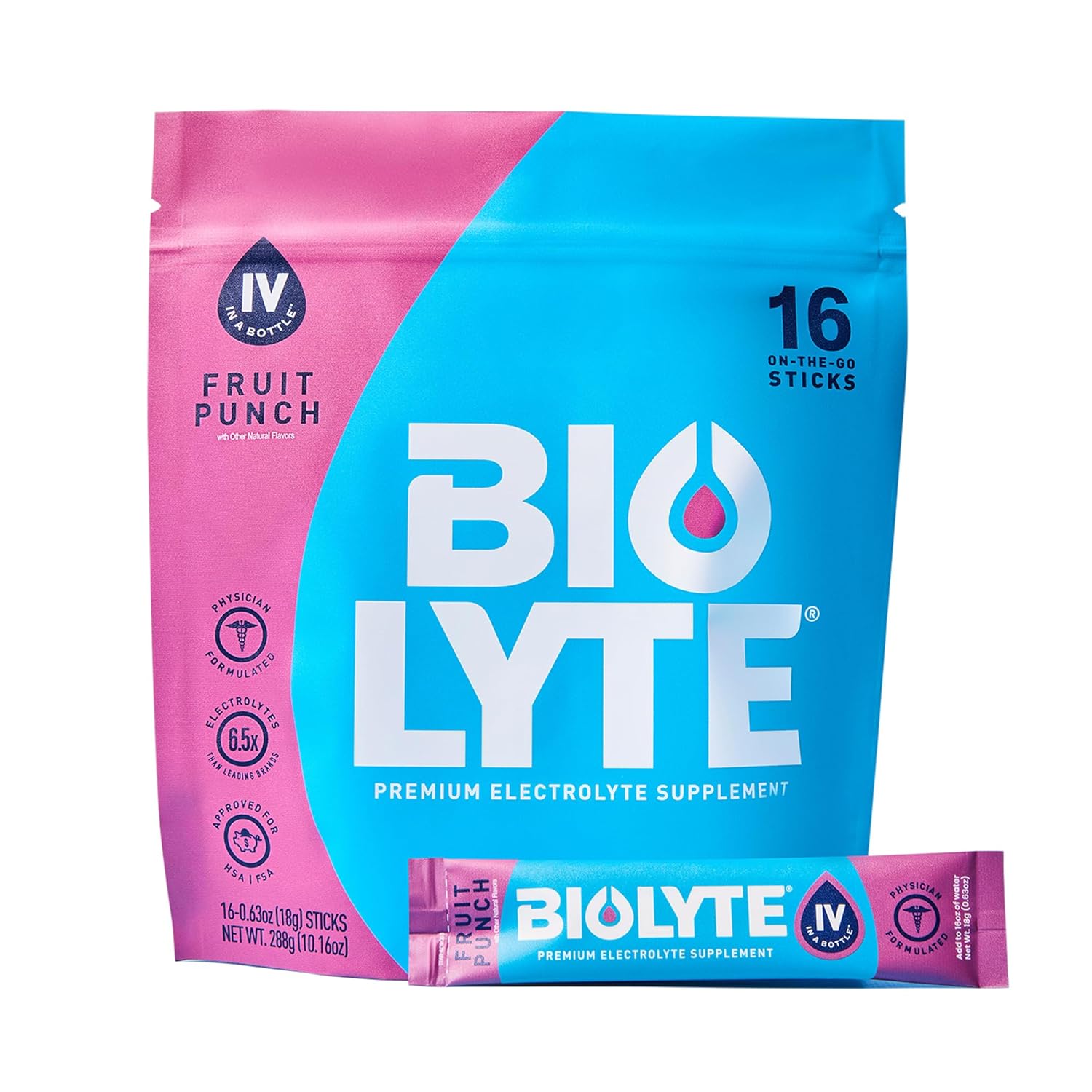
The correct formulation target is a small amount of glucose — enough to saturate the SGLT1 cotransporter and maximize sodium co-transport, without enough sugar to create osmotic symptoms or the glucose spikes that affect some patients. This is the oral rehydration standard. BIOLYTE's formulation sits closer to that profile than most consumer electrolyte products: high electrolyte concentration, a modest glucose component to drive absorption, without the sugar content of conventional sports drinks that overwhelms the system in the other direction.
The single-serving format matters practically: it allows consistent, measured dosing throughout the day rather than estimating from a large container. For patients managing symptoms through transitions — waking, upright activity, meals — portioned delivery is more useful than ad hoc guessing.
How to Use Electrolytes Strategically
Timing is as important as quantity. The most useful windows for electrolyte intake in POTS and dysautonomia are before rising in the morning (when orthostatic stress is highest after overnight horizontal rest), before any planned upright activity, and after meals (when the digestive system diverts blood flow and orthostatic symptoms often worsen). Spacing intake across the day produces better sustained plasma osmolality than a single large dose.
Electrolytes work best as part of a layered management approach — alongside compression, physical reconditioning, sleep position management, and (where indicated) medication. They are a meaningful piece of the picture. The goal is not to cure the regulatory problem. The goal is to reduce the amplitude of the symptoms that regulatory problem produces, while longer-term interventions address the underlying system.
That is a real and worthwhile goal. Manage the frame correctly, and electrolytes become a reliable part of the toolkit rather than a source of disappointment when they don't do what the standard narrative promises.