

Air Purifier for MCAS and Dysautonomia — Reducing Environmental Triggers
Mast Cell Activation Syndrome and dysautonomia don't just occasionally appear in the same patient — they appear together often enough that clinicians treating one routinely screen for the other. The reasons are mechanistic, not coincidental. Mast cells are distributed throughout the body's connective tissue, and when they activate — releasing histamine, prostaglandins, and other mediators — they directly affect vascular tone, heart rate, and blood pressure regulation. In a system already struggling to maintain autonomic stability, that mast cell signal is not a minor perturbation. It is fuel on a fire.
One question worth sitting with: two people can live in the same building, breathe the same air, and have completely different responses to it. One develops symptoms — flushing, tachycardia, brain fog, GI distress. The other notices nothing. The environmental trigger didn't change. What changed is the underlying resilience of the regulatory system. This matters because it reframes the goal: you are not trying to eliminate environmental triggers entirely (that's not achievable), but to reduce the cumulative inflammatory load on a system that is already working harder than it should.
What Airborne Triggers Actually Do
Standard HEPA filters capture particles 0.3 microns and larger — a meaningful cutoff, but not the whole story. Many of the airborne irritants most relevant to MCAS patients operate at a smaller scale. Mold spores range from 1 to 30 microns and would be caught by standard HEPA, but the mycotoxins they release are far smaller. Volatile organic compounds — off-gassed from furniture, flooring, cleaning products, and paints — exist as gas-phase molecules that bypass particle filtration entirely. Fine particulate matter from combustion can reach 0.1 microns or smaller.
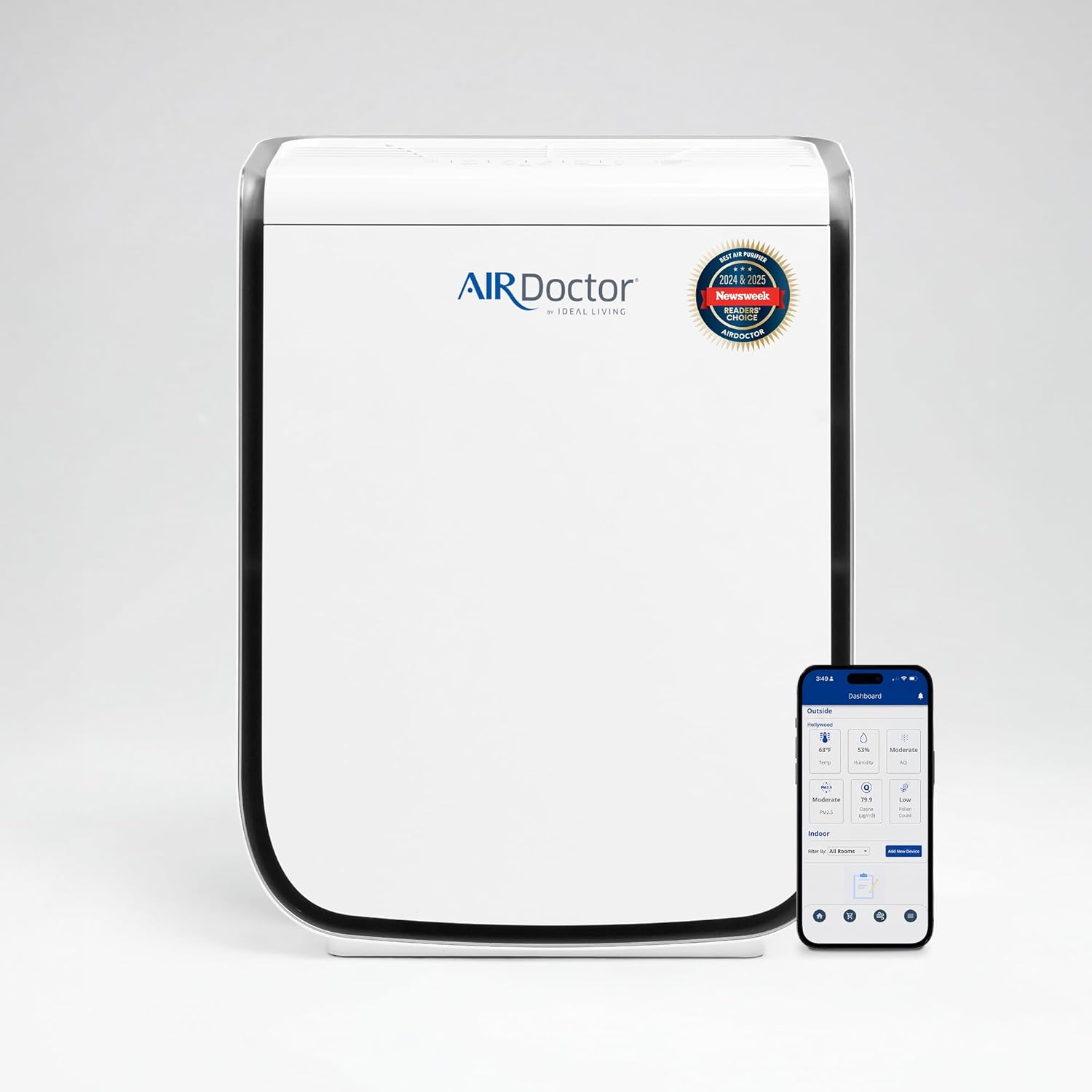
The AIRDOCTOR uses what it calls UltraHEPA filtration, rated to capture particles 0.003 microns and larger — 100 times smaller than the standard HEPA threshold. It pairs this with an activated carbon and VOC filter designed to adsorb gas-phase compounds. For a patient population that frequently reports sensitivity to perfumes, cleaning products, and building materials, the VOC stage is not optional — it's the part that matters most for chemical sensitivities.
The Bedroom Case
The most defensible case for air purification in this population is the bedroom. Eight hours of uninterrupted, continuous exposure to whatever is in your ambient air — while your body is in its most vulnerable, least defended state — is a different proposition than passing through a polluted space briefly during the day. The autonomic system doesn't fully rest during sleep; it continues regulating. And if that regulatory work is happening against a background of ongoing mast cell activation from inhaled irritants, sleep quality and morning symptom load are both affected.
Running an air purifier continuously in the bedroom, rather than intermittently in common areas, concentrates the benefit where the exposure duration is highest. The AIRDOCTOR is sized for bedrooms and medium rooms up to roughly 600 square feet, with a sleep mode that reduces fan speed and dims indicators for night operation.
Where This Fits in the Larger Picture
It is worth being direct about what an air purifier does and doesn't do. It reduces one category of environmental input to an already reactive system. It does not address dysautonomia at its source. It does not repair baroreflex function, restore blood volume, or recalibrate autonomic tone. What it does is remove one set of upstream triggers — and in a condition where the feedback loops that amplify symptoms are self-reinforcing, reducing any input that activates those loops has value.
The MCAS-dysautonomia-hypermobility cluster is increasingly recognized as a coherent clinical picture. Why hypermobility and dysautonomia appear together is an active area of research — connective tissue abnormalities may predispose both to mast cell dysfunction and to structural features that affect autonomic nerve function. Managing environmental triggers is one lever in a larger set of adjustments most patients need to make.
The standard clinical advice for MCAS includes trigger avoidance alongside mast cell stabilizers and antihistamines. Trigger avoidance is the part patients have the most direct control over. For the airborne component of that — which is significant in most indoor environments — consistent, high-quality filtration in sleeping and living spaces is one of the more practical interventions available.
Practical Considerations
Filter replacement is the hidden cost in any air purifier decision. The AIRDOCTOR uses a two-stage system: a pre-filter (washable) and the UltraHEPA/carbon combination filter (replaceable, roughly every six to twelve months depending on usage and local air quality). Factor this into your cost calculation. Also consider placement: placing the unit near the room's air supply or return, and keeping the bedroom door closed while running it, maximizes the air changes per hour within the space you're actually sleeping in.
For patients with significant chemical sensitivities, it may be worth running the unit for 30 minutes before entering the room after any cleaning or product use, allowing it to clear any off-gassed compounds first.